Tag Archives: TAA Power Supply

Understanding MIL-STD-461: Electromagnetic Compatibility Standards for Mission-Critical Electronics

Understanding MIL-STD-461: Electromagnetic Compatibility Standards for Mission-Critical Electronics

When it comes to designing electronics for military use—whether it’s in an aircraft, ship, ground vehicle, or satellite—failure is not an option. These systems must operate flawlessly in environments filled with electromagnetic interference (EMI), from radar systems to high-powered transmitters. That’s where MIL-STD-461 comes in.

In this blog, we’ll unpack what MIL-STD-461 is, who it applies to, what it tests for, and how manufacturers achieve compliance.


 What Is MIL-STD-461?

MIL-STD-461 is a U.S. Department of Defense (DoD) standard that defines the requirements and test methods for controlling electromagnetic interference (EMI) in military electronic equipment and subsystems.

Its purpose is to ensure that electronic systems:

  • Don’t emit harmful interference

  • Can resist incoming EMI from external sources

First issued in 1967, MIL-STD-461 has been updated several times, with the current version being MIL-STD-461G (released in 2015). It works hand-in-hand with MIL-STD-464, which sets system-level EMC requirements.


 Who Uses MIL-STD-461?

MIL-STD-461 applies to:

  • Defense contractors building military electronics

  • Aerospace OEMs (aircraft, spacecraft, missiles)

  • Naval and ground vehicle systems (ships, tanks, drones)

  • Subcontractors providing sensors, computers, power supplies, or RF systems

If your product is destined for a DoD platform or program, you’ll likely need to show proof of compliance with MIL-STD-461.


What Does MIL-STD-461 Test?

The standard is divided into test methods, each focused on either emissions or susceptibility across various frequency ranges.

Here’s a quick breakdown of the most common tests:

 Emissions – What Your System Puts Out

Test Code Description Frequency Range
CE101 Conducted emissions (power leads) 30 Hz – 10 kHz
CE102 Conducted emissions (power leads) 10 kHz – 10 MHz
RE101 Radiated emissions (magnetic field) 30 Hz – 100 kHz
RE102 Radiated emissions (electric field) 10 kHz – 18 GHz
RE103 Radiated emissions (transmitters) Transmitter-dependent

 Susceptibility – What Your System Must Withstand

Test Code Description Frequency Range
CS101 Conducted susceptibility (power leads) 30 Hz – 150 kHz
CS114 Bulk cable injection 10 kHz – 200 MHz
CS115 Impulse excitation (fast transients) Repetitive narrow pulses
CS116 Damped oscillatory transients 10 kHz – 100 MHz
RS101 Radiated susceptibility (magnetic) 30 Hz – 100 kHz
RS103 Radiated susceptibility (electric) 10 kHz – 18 GHz

How Is Compliance Achieved?

Meeting MIL-STD-461 is not just about passing tests—it’s about designing for EMC from day one. Here’s how manufacturers approach it:

1. Pre-Compliance Design

  • Use shielded enclosures to block RF noise

  • Implement power line filters and ferrites

  • Use twisted pair and shielded cables

  • Optimize PCB layout to reduce emissions and susceptibility

Using products designed to meet Mil-Std 461 EMC requirements will cut down on your pre-compliance time.

2. Testing in Accredited Labs

  • Equipment Under Test (EUT) is placed in a shielded chamber

  • Specialized equipment (spectrum analyzers, signal generators, antennas) simulate and measure EMI

  • Testing is done according to procedures outlined in MIL-STD-461G

 Passing means the system won’t interfere with others or be disrupted by nearby emissions—even in dense EMI environments like naval ships or aircraft carriers.

3. Documentation & Reporting

  • Create a Test Plan (TP) and Test Report (TR) that outline procedures, results, and any deviations

  • Submit to program offices, DoD, or certification bodies for review


 Typical Compliance Process

  1. Determine Applicability: Based on equipment type, platform (air/ground/sea), and power specs.

  2. Select Test Methods: From the MIL-STD-461 matrix.

  3. Design for EMC: Build to meet limits.

  4. Conduct Pre-Compliance Testing: In-house or with third-party labs.

  5. Perform Formal Testing: With accredited test lab.

  6. Document Results: Create reports for certification or government submission.


 What Happens If You Fail a Test?

Failure is common in early stages. Here’s how it’s handled:

  • Modify design (e.g., improve shielding, change cable routing)

  • Add filtering or grounding

  • Redesign power supplies or connectors

  • Retest affected section only

This iterative process improves product robustness and avoids costly fixes later in the program lifecycle.


 Why MIL-STD-461 Matters

Electromagnetic compatibility is essential to mission success. Without proper EMC, electronics could:

  • Jam nearby radios or sensors

  • Misbehave during operations (missile control, radar)

  • Become vulnerable to cyber or signal disruption

MIL-STD-461 ensures that your product won’t become the weakest link in the battlefield or the cockpit.


 ETA-USA’s Compliant Products

MIL-STD-461 is the backbone of electromagnetic compatibility in military systems. It’s not just a box to check—it’s a design mindset that ensures electronics can survive and operate in today’s complex and contested environments.

ETA-USA offers COTS/MOTS Mil-Std 461 compliant power supplies

AC/DC Conduction Cooled CH-M series:

CH-M500: 500W 

CH-M1000: 1000W

CH-M2000: 2000W

AC/DC low profile Mil-S-901 LPM Series

LPM500: 500W

LPM650: 650W with droop sharing

LPM1000: 1,000W 

DC/DC Mil-Std 1275 compliant Conduction Cooled MDC Series

MDC150: 150W

MDC300: 300W

MDC500: 500w

Whether you’re building mission-critical avionics, battlefield sensors, or tactical communications gear, understanding and applying MIL-STD-461 early in your project helps you avoid surprises, reduce costs, and earn the trust of defense customers. Let ETA-USA assist you in creating a MIL-STD compliant power supply.
Replacing Your Power Supply from High Tariff Sources

Tariffs are a fact of life and will be for the near future. If you are designing a new product or have a current product and need to replace your power converter, this article will help you.

  • Learn how TAA sourcing will mitigate the risk of fluctuating tariffs from eating at your bottom line.
  • Show you how to find a replacement power supply/ power converter for your application
  • Explain the additional considerations needed when you are qualifying a new power converting product for your design. 

What is TAA Compliance and How Can it Help Me?

TAA stands for the Trade Agreements Act, a U.S. law that was created to make sure that products the U.S. government buys come from countries the U.S. has trade agreements.

What is “TAA Compliance”?

When a product is TAA compliant, it means:

  • It is made or substantially transformed (significantly changed) in:

    • The United States, or

    • A country that the U.S. has a trade agreement with (like Japan, Taiwan, or South Korea).

Doesn’t the US have a Trade Agreement with China?

This can be a point of confusion. While the United States and China engage in extensive trade, China is not considered a “designated country” under the Trade Agreements Act (TAA). This means that products made in China are generally not TAA compliant and cannot be sold to the U.S. federal government under contracts that require TAA compliance.

In addition, Chinese products have been the target of increasing tariffs and excluded from sales to the US Federal Government. In 2025, the US government has made a deliberate effort to reduce the amount of Chinese imports into the US, which is expected to continue in the near future. 

But the US Government Plans on Adding Tariffs on All of its Trading Partners, why Should I Consider TAA Sources?

The best strategy is to source from a supplier that will provide the most stable pricing. Luckily, all of ETA-USA’s products are TAA Compliant and not subject tariffs directed at China. 

How do I Select the right Power Supply?

You can read the post Selecting the Right Power Supply for more in depth information, but to explain briefly. 

  1. Identify your power conversion need and power consumption.
    • Do you need an AC/DC converter? ETA-USA’s line of AC/DC switching power supplies accept universal input and can be used worldwide
    • Do you need a DC/DC converter? ETA-USA has a line of wide input DC/DC converters to save you the time of replacing parts that accept different input voltages. 
    • What about the Watts? The rated wattage  on a power supply  is calculated by multiplying the output voltage (Volts, typically DC voltage) by the output current (Amps). You will want to make sure the voltage matches as close as possible, but you can always oversize the current rating without damaging your product, the job of the  power supply will deliver only what your product demands.
  2. Check the fit of your replacement
    • Switching power supplies come in a variety of forms, but this can easily me solved:
      • ETA-USA has recently introduced a line of power dense AC/DC converters that have a smaller footprint than most products on the market.
      • See PFT65 , PFT150 , and PFT300
      • ETA-USA’s technical team can help you design an adapter plate to fit your new supply in your old chassis.
  3. Check the Connection between the power supply and  your system
    • Most of ETA-USA’s AC/DC and DC/DC power supplies interface with standard terminal rings or headers.
    • For AC/DC external adapters, ETA-USA can accommodate a modification to the DC output cable assembly with low MOQ (30 pcs production, 1-2 evaluation units) without significant impact on price of safety certifications
  4. What type of third party safety or standards do I need to adhere to?
    • Unless you have a product that will be used in a medical application, you just need a power supply  that has ITE certification that meets the harmonized standard of IEC62368-1, which can be found on many of ETA-USA products. 
      • Different regions may require that the certifying body be specific. ETA-USA products are certified for North and South America, Europe, and Japan. 
    • If your product is being used in a medical application, you will need 60601 certification. To learn more, read the blog post about ITE vs Medical Grade Power Supplies.
    • If you are replacing a low voltage, low power DC-DC  converter, you will likely not need to be concerned about third party certification. 

It may be daunting, but ETA-USA is here to help. Contact a representative with your switching power supply requirements today! 

Ingress Protected & Ruggedized AC/DC Power Supplies

PROTECTED FROM THE ELEMENTS!

Ingress Protected (IP Rated) AC/DC Power Supplies 

ETA-USA offers ITE, Medical, and Ruggedized AC/DC Power supplies for your application. 

Contact an ETA-USA Representative for ordering information, pricing, lead times, and CAD models. Products can be built in as little as 5 weeks

IP42 Rated ITE & Medical Grade AC/DC Adapters


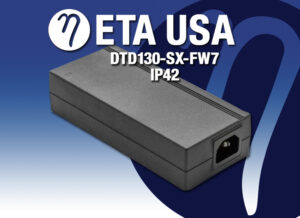
DTD130 Series-IP42 DOE VII AC/DC External Adapter

IP42 130W ITE AC/DC Adapter
Click on Image for Datasheet
  • Universal Input 90~264 VACin; 50/60Hz with 3-prong IEC320-C14, Class I AC inlet (Standard)
  • Optional IEC320-C6, -C8, or -C18 AC inlet available upon request
  • Meets DOE VII and EU ErP power consumption requirements
  • ITE rated 5000m
  • Output Voltages: 12, 19, 24,  36, & 48 VDC
  • -20C~+60C operational temperature
  • >300,000 hour MTBF (Telcordia SR-332)
  • Custom DC cable and connector options with Low MOQ

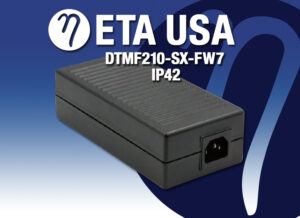
DTMF210 Series-IP42 DOE VII AC/DC External Adapter

IP42 210W AC/DC Adapter ITE and Medical
Click on Image for Datasheet
  • Universal Input 90~264 VACin; 50/60Hz with 3-prong IEC320-C14, Class I AC inlet
  • Meets DOE VII and EU ErP power consumption requirements
  • ITE rated 5000m & Medical rated 3000m operational altitude
  • 2X MOOP
  • Output Voltages: 12, 15, 19, 24, 28, 36, & 48 VDC
  • -20C~+60C operational temperature
  • >350,000 hour MTBF (Telcordia SR-332)
  • Custom DC cable and connector options with Low MOQ

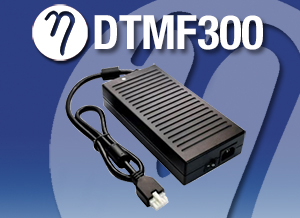
DTMF300 Series-DOE VI AC/DC External Adapter

Click Image for Datasheet
  • Universal Input 90~264 VACin; 50/60Hz with 3-prong IEC320-C14, Class I AC inlet with I/O switch (Standard)
  • Optional IEC320-C6, -C8, or -C18 AC inlet available upon request
  • Meets IP42 if ordered without I/O switch
  • Meets DOE VI power consumption requirements
  • ITE rated 5000m & Medical rated 5000m operational altitude
  • 2X MOOP
  • Output Voltages: 12, 15, 19, 24,  28, 48 & 54 VDC
  • -30C~+60C operational temperature
  • >200,000 hour MTBF
  • Custom DC cable and connector options with Low MOQ

DTMF400 Series-DOE VI AC/DC External Adapter

Click Image for Datasheet
  • Universal Input 90~264 VACin; 50/60Hz with 3-prong IEC320-C14, Class I AC inlet 
  • Meets IP42 
  • Meets DOE VI power consumption requirements
  • ITE rated 5000m & Medical rated 3000m operational altitude
  • 2X MOOP
  • Output Voltages: 12, 19, 24,  28, 48 VDC
  • -30C~+60C operational temperature
  • >230,000 hour MTBF
  • Custom DC cable and connector options with Low MOQ


Ruggedized Semi-Custom IP6x  AC/DC Power Supplies

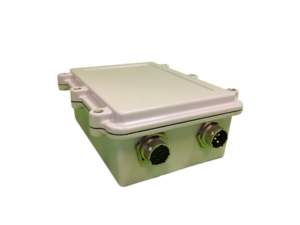
HZD500 Series- 500W IP66 Rated Power Supply Designed for Explosive Environments 

Click on Image for Datasheet
  • Universal input: 90~264 VAC in; 50/60/400Hz
  • Output voltages: 12, 24, 28, 48 (fixed)
  • IP67 rated enclosure. IP66 rated for Hazardous Environments 
  • Meets IEC 60079-0 2017: General & IEC 60079-7: 2015 safety “E” (with connector housing)
  • IP64 version with Power On LED and output-off signal available 
  • Pole Mount Heatsink available for high temp environments
  • Optional Mil-Std 461 CE  102 Compliant model available
  • Powder Coat, anodized, or chem-film chromate finishes available.

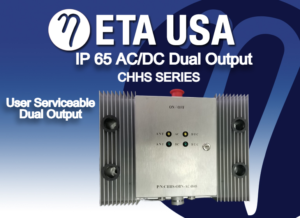
CHHS Series- 1400W IP67 Dual Output Power Supply-User Serviceable 

Click Image for Datasheet
  • Universal input: 90~264 VAC in; 50/60/400Hz
  • Two isolated 700W power modules with floating outputs
  • Output Voltages: 12, 24, 28, 48 (fixed)
  • IP67 rated enclosure with Optional Heatsink for High Temperature Environments 
  • Power On and Output Good LED
  • Emergency Shut Off switch 
  • User serviceable interface with cord grips for customer wiring

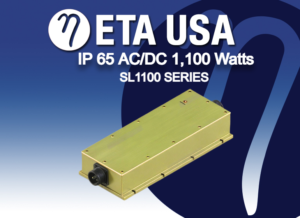
SL1100 Series- 1,100W IP65 Slim Form Factor 

Click Image for Datasheet
  • Universal input: 90~264 VAC in; 50/60/400Hz
  • Output voltages: 12, 24, 28, 48 (Non Standard Voltages 9V~56 available upon request)
  • Output Power On LED
  • SAE 5015 I-O or Permanent Wired Interface options
  • Operating Temperature (Ambient): -40°C~+70°C 
  • Additional Options: Remote On/Off, external voltage trim (10%, 20%), Vout, Iout, and internal temperature reporting (I2C protocol), Anodized Enclosure
  • Can be ordered to meet Mil-Std 461 EMI (CE101, CE102, RE102, RE103) & Mil Std 1399
  • RoHS and Non-RoHS versions available

ETA-USA has over 30 years of industry experience providing custom power supply solutions to its customers. Additional custom requirements are welcomed.