
Tag Archives: Mil-Std 810

Understanding MIL-STD-461: Electromagnetic Compatibility Standards for Mission-Critical Electronics

Understanding MIL-STD-461: Electromagnetic Compatibility Standards for Mission-Critical Electronics

When it comes to designing electronics for military use—whether it’s in an aircraft, ship, ground vehicle, or satellite—failure is not an option. These systems must operate flawlessly in environments filled with electromagnetic interference (EMI), from radar systems to high-powered transmitters. That’s where MIL-STD-461 comes in.

In this blog, we’ll unpack what MIL-STD-461 is, who it applies to, what it tests for, and how manufacturers achieve compliance.


 What Is MIL-STD-461?

MIL-STD-461 is a U.S. Department of Defense (DoD) standard that defines the requirements and test methods for controlling electromagnetic interference (EMI) in military electronic equipment and subsystems.

Its purpose is to ensure that electronic systems:

  • Don’t emit harmful interference

  • Can resist incoming EMI from external sources

First issued in 1967, MIL-STD-461 has been updated several times, with the current version being MIL-STD-461G (released in 2015). It works hand-in-hand with MIL-STD-464, which sets system-level EMC requirements.


 Who Uses MIL-STD-461?

MIL-STD-461 applies to:

  • Defense contractors building military electronics

  • Aerospace OEMs (aircraft, spacecraft, missiles)

  • Naval and ground vehicle systems (ships, tanks, drones)

  • Subcontractors providing sensors, computers, power supplies, or RF systems

If your product is destined for a DoD platform or program, you’ll likely need to show proof of compliance with MIL-STD-461.


What Does MIL-STD-461 Test?

The standard is divided into test methods, each focused on either emissions or susceptibility across various frequency ranges.

Here’s a quick breakdown of the most common tests:

 Emissions – What Your System Puts Out

Test Code Description Frequency Range
CE101 Conducted emissions (power leads) 30 Hz – 10 kHz
CE102 Conducted emissions (power leads) 10 kHz – 10 MHz
RE101 Radiated emissions (magnetic field) 30 Hz – 100 kHz
RE102 Radiated emissions (electric field) 10 kHz – 18 GHz
RE103 Radiated emissions (transmitters) Transmitter-dependent

 Susceptibility – What Your System Must Withstand

Test Code Description Frequency Range
CS101 Conducted susceptibility (power leads) 30 Hz – 150 kHz
CS114 Bulk cable injection 10 kHz – 200 MHz
CS115 Impulse excitation (fast transients) Repetitive narrow pulses
CS116 Damped oscillatory transients 10 kHz – 100 MHz
RS101 Radiated susceptibility (magnetic) 30 Hz – 100 kHz
RS103 Radiated susceptibility (electric) 10 kHz – 18 GHz

How Is Compliance Achieved?

Meeting MIL-STD-461 is not just about passing tests—it’s about designing for EMC from day one. Here’s how manufacturers approach it:

1. Pre-Compliance Design

  • Use shielded enclosures to block RF noise

  • Implement power line filters and ferrites

  • Use twisted pair and shielded cables

  • Optimize PCB layout to reduce emissions and susceptibility

Using products designed to meet Mil-Std 461 EMC requirements will cut down on your pre-compliance time.

2. Testing in Accredited Labs

  • Equipment Under Test (EUT) is placed in a shielded chamber

  • Specialized equipment (spectrum analyzers, signal generators, antennas) simulate and measure EMI

  • Testing is done according to procedures outlined in MIL-STD-461G

 Passing means the system won’t interfere with others or be disrupted by nearby emissions—even in dense EMI environments like naval ships or aircraft carriers.

3. Documentation & Reporting

  • Create a Test Plan (TP) and Test Report (TR) that outline procedures, results, and any deviations

  • Submit to program offices, DoD, or certification bodies for review


 Typical Compliance Process

  1. Determine Applicability: Based on equipment type, platform (air/ground/sea), and power specs.

  2. Select Test Methods: From the MIL-STD-461 matrix.

  3. Design for EMC: Build to meet limits.

  4. Conduct Pre-Compliance Testing: In-house or with third-party labs.

  5. Perform Formal Testing: With accredited test lab.

  6. Document Results: Create reports for certification or government submission.


 What Happens If You Fail a Test?

Failure is common in early stages. Here’s how it’s handled:

  • Modify design (e.g., improve shielding, change cable routing)

  • Add filtering or grounding

  • Redesign power supplies or connectors

  • Retest affected section only

This iterative process improves product robustness and avoids costly fixes later in the program lifecycle.


 Why MIL-STD-461 Matters

Electromagnetic compatibility is essential to mission success. Without proper EMC, electronics could:

  • Jam nearby radios or sensors

  • Misbehave during operations (missile control, radar)

  • Become vulnerable to cyber or signal disruption

MIL-STD-461 ensures that your product won’t become the weakest link in the battlefield or the cockpit.


 ETA-USA’s Compliant Products

MIL-STD-461 is the backbone of electromagnetic compatibility in military systems. It’s not just a box to check—it’s a design mindset that ensures electronics can survive and operate in today’s complex and contested environments.

ETA-USA offers COTS/MOTS Mil-Std 461 compliant power supplies

AC/DC Conduction Cooled CH-M series:

CH-M500: 500W 

CH-M1000: 1000W

CH-M2000: 2000W

AC/DC low profile Mil-S-901 LPM Series

LPM500: 500W

LPM650: 650W with droop sharing

LPM1000: 1,000W 

DC/DC Mil-Std 1275 compliant Conduction Cooled MDC Series

MDC150: 150W

MDC300: 300W

MDC500: 500w

Whether you’re building mission-critical avionics, battlefield sensors, or tactical communications gear, understanding and applying MIL-STD-461 early in your project helps you avoid surprises, reduce costs, and earn the trust of defense customers. Let ETA-USA assist you in creating a MIL-STD compliant power supply.

MIL-STD-810: The Gold Standard for Rugged Equipment Testing

MIL-STD-810: The Gold Standard for Rugged Equipment Testing 

When designing equipment destined for military or harsh environments, one question always comes up: “How do I ensure my product will survive tough conditions?”

Enter MIL-STD-810 — the U.S. military’s cornerstone standard for environmental testing of equipment. If you want your product to be rugged, reliable, and ready for real-world use — this standard is your go-to guide.

In this post, we’ll explore what MIL-STD-810 is, why it matters, and how you can leverage it to build tougher products.


What is MIL-STD-810?

MIL-STD-810 ( Military Standard 810) is a test method standard developed by the U.S. Department of Defense. It outlines how to simulate environmental stresses that equipment might face in actual use — like temperature extremes, shock, vibration, dust, humidity, and more.

Instead of just guessing how a device will perform, MIL-STD-810 gives you a scientific, repeatable way to test durability.


Why MIL-STD-810 Matters

  • Real-World Relevance: The standard focuses on conditions soldiers and equipment actually face — desert heat, arctic cold, tropical humidity, rough transportation, and battlefield shock.

  • Product Confidence: Passing MIL-STD-810 tests means your device is tough enough for harsh conditions, which reassures users and buyers.

  • Market Access: Many government and defense contracts require MIL-STD-810 compliance or testing.

  • Rugged Brand Image: It’s a great marketing point for “ruggedized” consumer and industrial products too.


Key Test Categories in MIL-STD-810

MIL-STD-810 includes over 20 test methods, but some of the most common are:

1. Temperature Testing (High and Low)

  • Tests operation and storage in extreme cold and heat

  • Includes rapid temperature changes (thermal shock)

2. Humidity

  • Exposure to prolonged high humidity to check for corrosion and electrical failures

3. Vibration

  • Simulates vibrations from vehicles, aircraft, or rough handling during transport

  • Random and sinusoidal vibration profiles

4. Shock and Drop

  • Tests impact resistance to drops, bangs, and sudden shocks

5. Dust and Sand

  • Ensures protection against dust ingress during desert deployment or dusty environments

6. Rain and Water Spray

  • Tests resistance to rain, splashes, and water jets

7. Altitude

  • Simulates high-altitude conditions, including low pressure and cold


How Does MIL-STD-810 Testing Work?

1. Tailoring

  • MIL-STD-810 is not “one size fits all.”

  • You tailor the test plan based on the equipment’s expected environment — for example, if your device is for naval use, you might focus more on salt fog and humidity tests.

2. Test Setup

  • Testing is performed using specialized chambers and equipment replicating the conditions (e.g., environmental chambers, vibration tables, shock machines).

3. Pass/Fail Criteria

  • Your device must maintain functionality and avoid physical damage during and after testing.


Common Myths About MIL-STD-810

Myth 1: It’s a checklist of tests you must pass.
Truth: MIL-STD-810 is a guide. You select and tailor the tests based on your product’s mission profile.

Myth 2: Passing MIL-STD-810 means your product is indestructible.
Truth: It means your product meets specific environmental criteria — not that it can survive every possible scenario.


Practical Tips for Using MIL-STD-810

  • Understand Your Environment: Talk to users and study the deployment scenario before picking tests.

  • Start Early: Incorporate ruggedness into design before testing. Testing late can be costly.

  • Document Everything: Test setups, procedures, and results should be well documented for certification and troubleshooting.

  • Work with Experienced Labs: Accredited test labs can guide you through test tailoring and execution.


The MIL-STD-810H standard outlines environmental test methods for military equipment—including power supplies—to ensure their reliability and durability under harsh operating conditions. While MIL-STD-810 doesn’t contain “pass/fail” criteria by itself, it provides test procedures that manufacturers must perform to simulate real-world environments.

Below is a breakdown of MIL-STD-810H methods that commonly apply to power supplies, along with what they test and typical criteria:


Relevant MIL-STD-810H Methods for Power Supplies

Method Test Name Purpose for Power Supplies
500.6 Low Pressure (Altitude) Ensures performance at high altitudes; tests for arcing and insulation breakdown.
501.7 High Temperature Tests operation and storage at elevated temperatures.
502.7 Low Temperature Verifies function in cold environments (down to -51 °C for storage).
503.7 Temperature Shock Ensures survival during sudden changes in temperature (e.g., −40 °C to +70 °C in <1 min).
505.7 Solar Radiation (Sunshine) For exposed systems—tests UV aging, heating, and material degradation.
506.7 Rain / Blowing Rain For waterproof enclosures—tests ingress protection. Often paired with IP ratings.
507.7 Humidity Tests for condensation, corrosion, and insulation failure in humid environments.
508.8 Fungus For organic insulation or coatings—ensures materials don’t degrade when exposed to biological growth.
509.7 Salt Fog Simulates marine environments—important for corrosion resistance of PCB and connectors.
510.7 Sand and Dust Ensures enclosures are sealed against particulate intrusion.
514.8 Vibration Simulates vibration from transport, launch, or shipboard operations (e.g., helicopters or submarines).
516.8 Shock Drop and mechanical shock resistance—tests unit survivability.
521.4 Icing/Freezing Rain Tests surface and mechanical function after ice accumulation.
528.1 Mechanical Vibrations of Shipboard Equipment (Type I) Simulates shipboard vibration patterns—particularly relevant to submarines and naval systems.

Criteria and How They Apply to Power Supplies

MIL-STD-810 does not prescribe fixed pass/fail limits. Instead:

  • You define the operational and non-operational limits based on:

    • Your power supply’s intended deployment (e.g., aircraft, submarine, desert).

    • Customer specs (military, defense contractors).

    • Mission profile data.

Example: For Method 501.7 (High Temp)

  • Operating temp range may be defined as: 0 °C to 70 °C

  • Storage temp range may be −40 °C to 85 °C

  • You must demonstrate the PSU functions normally during and after exposure within those parameters.


Example: A Power Supply for Naval/Submarine Use

Let’s say you’re qualifying a rugged DC-DC power supply for a submarine:

Test Application Typical Limits
509.7 (Salt Fog) Prevents corrosion of terminals & PCBs 5% salt solution for 48 hours
507.7 (Humidity) Tropical/humid deployments 95% RH, 30–60 °C for 10 days
516.8 (Shock) Resists dropping or explosion shock 40g for 11 ms
514.8 (Vibration) Shipboard vibration (per MIL-STD-167) Profile depends on mounting type

Summary: Design Considerations for Compliance

To pass MIL-STD-810H tests, your power supply must include:

  • Robust mechanical design: shock-absorbing mounts, ruggedized enclosures

  • Thermal management: heatsinks, thermal pads, proper derating

  • Conformal coating or potting: for humidity, fungus, and salt fog resistance

  • Connector and housing sealing: dustproof, waterproof designs (often IP65+)

  • Low EMI emissions and high immunity: Often paired with MIL-STD-461G

Common Environmental Parameters for MIL-STD-810 Power Supplies

Category Typical Design Parameters Relevant Test Methods
Operating Temperature –40 °C to +70 °C (sometimes –55 °C to +85 °C) 501.7 (High Temp), 502.7 (Low Temp)
Storage Temperature –55 °C to +85 °C 501.7, 502.7
Altitude / Pressure Up to 15,000–40,000 ft (depending on use) 500.6 (Low Pressure)
Humidity 95% RH, cycling 30–60 °C for 10–14 days 507.7
Salt Fog 5% NaCl solution, 48–96 hours 509.7
Fungus Resistance 28-day exposure, ASTM G21 compliant 508.8
Thermal Shock –40 °C to +70 °C, 5–10 cycles 503.7
Solar Radiation (if exposed) 24h/day cycles for 10 days, UV spectrum 505.7

Mechanical Stress Parameters

Stress Type Common Test Limits Method
Vibration (Random / Shipboard) 1.0–7.7 Grms, 5–500 Hz, 1 hr/axis (X, Y, Z) 514.8 (Category 4, 20, 24)
Mechanical Shock 20–40 g, 11–18 ms, half-sine, 3 axes 516.8
Drop Shock 1-meter drop, unpowered 516.8 (Proc IV)
Shipboard Vibration 5–33 Hz sinusoidal, 1 hr/axis 528.1
Ingress Protection IP65 to IP67 (for outdoor/submarine enclosures) Supplementary

Materials and Construction Expectations

Parameter Typical Requirement
Coating (PCB) Conformal coating (MIL-I-46058C or IPC-CC-830)
Sealing Waterproof gaskets, epoxy, or potted enclosures
Corrosion Resistance Anodized, stainless, or marine-grade coatings
Connectors MIL-grade circular or shielded connectors
Shock Mounting Rubberized isolation for PCB or chassis

Electrical Performance Under Environmental Stress

Test Typical Requirement
Voltage Regulation ±1–5% across temp and load
Output Ripple <100 mV (varies with application)
Efficiency 80% or higher (often 85–90%)
Hold-Up Time 10–20 ms minimum
EMC Compliance MIL-STD-461G (often required jointly)
Thermal Protection Internal shutdown above 85–95 °C
Overvoltage / Short Circuit Self-recovery or fail-safe modes

ETA-USA Mil-Std compliant power supplies are designed to meet the non-operational storage temperature and vibration/shock specifications for transportation. All units are conformally coated to mitigate salt fog exposure and humidity requirements during operation.  For specific environmental conditions, contact an ETA-USA representative, our technical team respond in less than 24 hours for all technical questions. 

US Government and Defense industry customers are recommended to view our capability statement

MILITARY GRADE PRODUCT – 2,000W Conduction Cooled AC/DC Power Supply

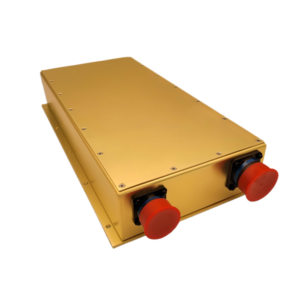
CH-M2000 Series- Military Grade Conduction Cooled AC/DC Power Supply
ETA-USA line of conduction cooled military grade AC/DC power supplies provide the single solution to power your military & defense application. Customers may use the standard input & output connector or request their own. Meets Mil-std 461G ground, airborne, and ship-board systems including Mil-std 1399 sec 300 for 50/60 Hz systems. Units can be built in as little as 5 weeks.

Click on Image for Datasheet

Features

  • Input: 95~264 VAC in, 50/60/400 Hz (47~440Hz) operation
  • Available voltages: 12, 24, 28, 48
  • In-rush current limited
  • 8″ x 14″ footprint (excluding connectors)
  • Aluminum Enclosure with chromate finish for corrosion resistance and low resistance bonding
  • Conformal coated internal circuitry
  • Mounting: Two rows of five, 0.20″ diameter thru holes for secure mounting and thermal conductivity
  • >20 msec Hold Up time at full load, 115VAC input, >50 msec at 220 VACin.
  • DC  Output Regulation: Less than 10 mV voltage drift from 0 to full load (measured at output terminal)
  • Ripple and Noise: <1% peak-to peak
  • Constant Current OCP Protection
  • Operating Altitude: 15,000ft & 40,000ft at 8 kPa (55,000 ft max)
  • Weight: 9.5 lbs (Standard Unit)

Mil-Standard Compliances (Without External Circuitry)

  • EMI: Mil-Std 461, CE101, CE102, RE102, RE103
  • Susceptibility: CS114, CS115
  • Input Transient Mil-Std 704
  • Surge protection: Mil-Std 1275
  • Power Factor: Mil-Std 1399 sec 300A
  • Meets Mil Std-1399 Sec 300A Power Profile for 115V 60Hz systems & CVN class 78
  • Environmental/Shock/Vibration: Mil-Std 810

Available Modifications

  • Hard Anodized Enclosure with EMI Grounding
  • Mil-Std 901 Shock Compliant Enclosure (Product Dimensions Subject to Change)
  • IP66 or IP67 Enclosure
  • Customized Input and Output Connector
  • External Voltage Trim (10%, 20%)
  • Remote On/Off
  • I2C Status Reporting (Output Voltage, Output Current, Internal Temperature)
  • Three Phase Wye or Delta Input (Contact ETA-USA Representative for Details)

Contact ETA-USA for Product Availability and CAD Files. 

See Our Full Line of Military and Aviation Power Supplies 

Government Customers- See Our Capability Statement


MILITARY GRADE PRODUCT – 500W Conduction Cooled AC/DC Power Supply

CH-M500 Series- Military Grade Conduction Cooled AC/DC Power Supply
ETA-USA line of conduction cooled military grade AC/DC power supplies provide the single solution to power you Mil-standard Application. Customers may use the standard input & output connector or request their own. Units can be built in as little as 5 weeks.

CH-M500 Mil-grade AC/DC
500W Military Grade Power supply. Click image for Datasheet 

Features

  • Input: 95~264 VAC in, 50/60/400 Hz (47~440Hz) operation.
  • In-rush current limited
  • Available voltages: 12, 24, 28, 48
  • Compact 5″x8″ footprint (excluding connectors)
  • Aluminum Enclosure with chromate finish for corrosion resistance and low resistance bonding
  • Conformal coated internal circuitry
  • Mounting: Two rows of five, 0.20″ diameter thru holes for secure mounting and thermal conductivity
  • >20 msec Hold Up time at full load, 115VAC input
  • DC  Output Regulation: Less than 10 mV voltage drift from 0 to full load (measured at output terminal)
  • Operating Altitude: 15,000ft & 40,000ft at 8 kPa (55,000 ft max)
  • Ripple and Noise: <1% peak-to peak


Mil-Standard Compliances (Without External Circuitry)

  • EMI: Mil-Std 461, CE101, CE102, RE102, RE103
  • Susceptibility: CS114, CS115
  • Input Transient Mil-Std 704
  • Surge protection: Mil-Std 1275
  • Power Factor: Mil-Std 1399 sec 300 for 50/60Hz systems
  • Environmental: Mil-Std 810

Available Modifications

  • Non-standard Voltages (Inquire with ETA-USA Representative)
  • Hard Anodized Enclosure with EMI Grounding
  • Mil-Std 901 Shock Compliant Enclosure (Product Dimensions Subject to Change)
  • External Voltage Trim (10%, 20%)
  • Sealed IP65/66/67 enclosure

Contact ETA-USA for Product Availability and CAD Files. 

See Our Full Line of Military and Aviation Power Supplies 

Government Customers- See Our Capability Statement

MILITARY GRADE PRODUCT – 1,000W Conduction Cooled AC/DC Power Supply

CH-M1000 Series- Military Grade Conduction Cooled AC/DC Power Supply

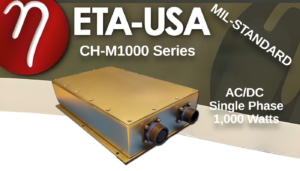
ETA-USA line of conduction cooled military grade AC/DC power supplies provide the single solution to power you Mil-standard Application. Customers may use the standard input & output connector or request their own. Designed for Mil-Std 461 Ground, Airborne, and Ship-board applications. Units can be built in as little as 5 weeks.

Link to CH-M1000 Datasheet
Click Image for Datasheet


Features

  • Input: 95~264 VAC in, 50/60/400 Hz (47~440Hz) operation.
  • Available voltages: 12, 24, 28, 48
  • In-rush current limited
  • Compact 7.5″ x 11″ footprint (excluding connectors)
  • Aluminum Enclosure with chromate finish for corrosion resistance and low resistance bonding
  • Conformal coated internal circuitry
  • Mounting: Two rows of five, 0.20″ diameter thru holes for secure mounting and thermal conductivity
  • >20 msec Hold Up time at full load, 115VAC input, >50 msec at 220 VACin.
  • DC  Output Regulation: Less than 10 mV voltage drift from 0 to full load (measured at output terminal)
  • Ripple and Noise: <1% peak-to peak
  • Constant Current OCP Protection
  • Operating Altitude: 15,000ft, 40,000ft at 8 kPa (55,000 ft max)
  • Weight: 5.5 lbs (Standard Unit)

Mil-Standard Compliances (Without External Circuitry)

  • EMI: Mil-Std 461, CE101, CE102, RE102, RE103
  • Susceptibility: CS114, CS115
  • Input Transient Mil-Std 704
  • Surge protection: Mil-Std 1275
  • Power Factor: Mil-Std 1399 (meets Mil-Std 1399 Sec 300 for 50/60Hz power systems)
  • Environmental: Mil-Std 810

Available Modifications

  • Non-standard Voltages from 5V~55 VDC (Contact ETA-USA Representative for Details)
  • Secondary isolated output voltages: 5, 12, 15, 24; 10W
  • Hard Anodized Enclosure with EMI Grounding
  • Mil-Std 901 Shock Compliant Enclosure (Product Dimensions Subject to Change)
  • IP66/IP67 Enclosure (Product Dimensions Subject to Change)
  • Customized Input and Output Connector
  • External Voltage Trim (10%, 20%)
  • Remote On/Off
  • Remote Sense
  • I2C Status Reporting (Output Voltage, Output Current, Internal Temperature)
  • Three Phase Wye or Delta Input (Contact ETA-USA Representative for Details)

Contact ETA-USA for Product Availability and CAD Files. 

See Our Full Line of Military and Aviation Power Supplies